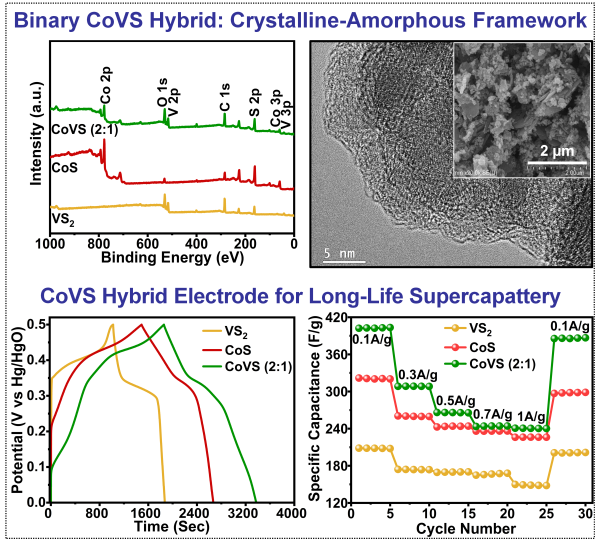
The rational engineering of CoS-modified VS2 (CoVS) hybrid electrodes through a facile solvothermal route facilitates rapid redox kinetics, efficient ion transport, and prolonged cycling stability for supercapattery applications. All-inclusive structural and surface analyses corroborate the formation of a well-integrated crystalline-amorphous CoVS framework with uniform elemental distribution and abundant electroactive sites. These features collectively improve electrolyte accessibility, ion diffusion, and reduce polarization during electrochemical operation. Synergistic coupling between the Co2+/Co3+ and V4+/V5+ redox couples further promotes charge-transfer kinetics and suppresses electrochemical polarization. As a result, the optimized CoVS (Co:V=2:1 molar ratio) electrode delivers a specific capacitance of 403.39 F g-1 (201.69 C g-1) at 0.1 A g-1, also retaining 61% of capacitance at a higher 1 A g-1, and maintaining 87.11% after 10000 cycles, which reflects the robust structural integrity of the hybrid electrode framework. Furthermore, the CoVS (2:1)//AC asymmetric device exhibits 125.69 F g-1 at 0.1 A g-1 within a 1.0 V window, achieving an energy density of 17.45 Wh kg-1 at a power density of 618 W kg-1. The device maintains 82.53% capacitance retention and 99% Coulombic efficiency after 10000 cycles, highlighting compositional synergy and controlled structural disorder as an effective strategy for high-rate, durable energy storage.